
Registrations of family MPVs and SUVs increased by 8% in Europe in the first quarter of 2024, despite the overall stagnation of the automotive market. Eco labels are now massively influencing purchasing criteria, as hybrid and electric powertrains surpass 40% market share in the segment. However, the diversity of offerings and the multiplication of technologies complicate the choice, even for experienced drivers. Manufacturers are multiplying safety and connectivity features, creating new standards that reshape the landscape for demanding families.
What families really want in 2025: between safety, space, and innovations
In 2025, the family car is no longer just a mundane question of the number of seats. Modern families scrutinize every feature with new demands: a trunk volume often exceeding 700 liters, flawless modularity, removable and foldable seats that have become essential. MPVs and ludospaces attract with their generous interior space, while SUVs focus on versatility and a raised driving position that reassures and offers better visibility on the road.
Inside, comfort no longer tolerates mediocrity. Seats must provide impeccable support, suspensions must smooth out bumps, and air conditioning must ensure even distribution. For large families, 7 to 9 real seats and numerous easily accessible storage compartments are essential. The Peugeot Tepee automatic has established itself as a benchmark on this issue, according to the detailed analysis published on CarburAuto.
Here’s how different formats meet the various user profiles:
- Vans: perfect for XXL families that need space and seating in abundance.
- Station wagons: ideal for those who want to combine dynamic road behavior with a spacious trunk.
- Hybrid or electric SUVs: appeal to those who want to drive as a family while managing their energy consumption.
Safety and embedded technologies now take precedence in the hierarchy of priorities. Fatigue detection, emergency braking, active lane keeping: each innovation aims to reassure and protect. Driver assistance and infotainment are no longer gadgets but decisive assets in the buying guide. Families seek peace of mind, and the state assists them in this endeavor through the eco bonus of up to €7,000 or the conversion bonus reaching €5,000 for the acquisition of a hybrid or electric vehicle.
The financial equation does not stop at the purchase price. Fuel consumption, maintenance, insurance costs: everything is scrutinized. The search for value for money is done over time, with a keen eye on reliability and total cost.
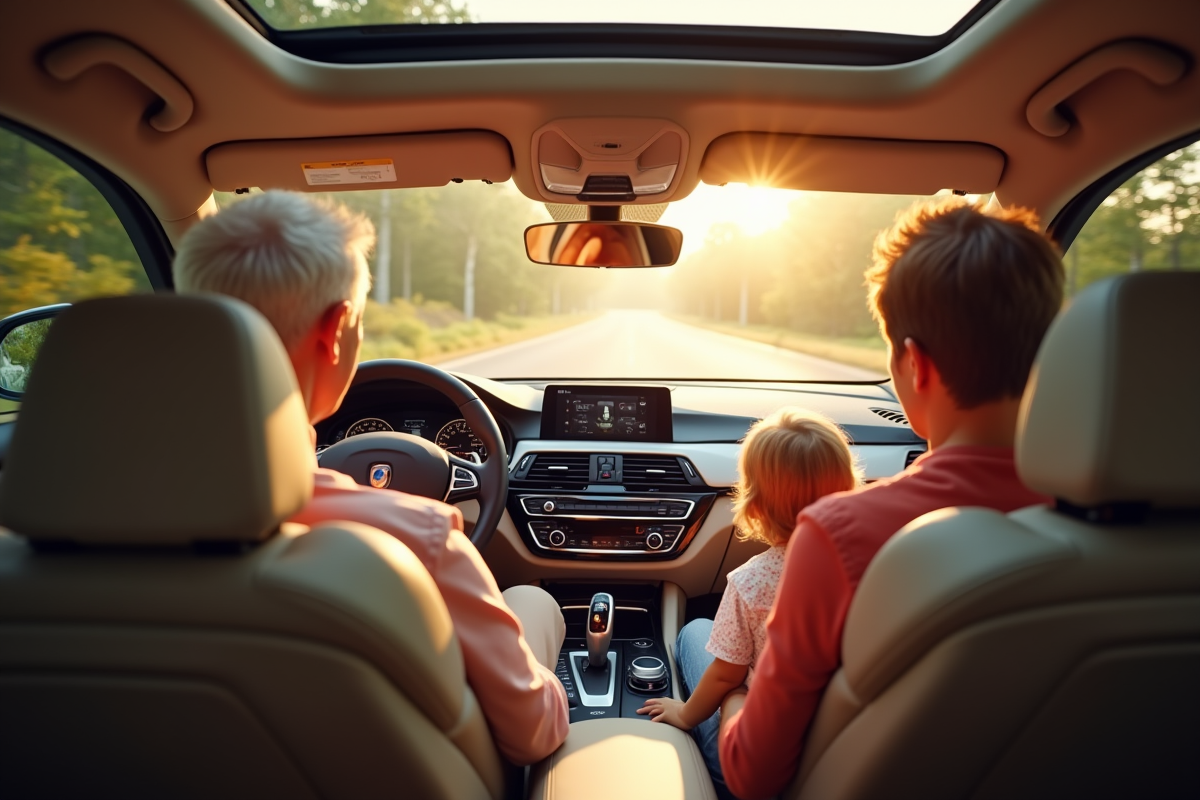
Comparison of essential family models: how to choose the ideal car according to your needs?
Choosing a family vehicle goes far beyond simply selecting a technical specification sheet. The onboard space, modularity, security, and budget management form the foundation of the decision. For large families, the number of seats remains crucial: the benchmark of 7 seats becomes the standard, with models like the Renault Grand Scénic (7 seats, trunk from 533 to 1,737 dm³) to the Peugeot 5008 offering 780 liters in a five-seat configuration.
The trunk volume carries significant weight in the decision-making process. Some concrete examples: up to 2,101 dm³ for the Renault Espace, from 708 to 2,094 liters for the Dacia Jogger, or 1,857 liters for the Volkswagen Touran. Vans such as the Volkswagen Caravelle, Renault Trafic, or Opel Vivaro are designed for extra-large families with their 9 seats. On the ludospace side, the Peugeot Rifter, Citroën Berlingo, or Renault Grand Kangoo embody versatility, thanks to their removable seats and modifiable space in the blink of an eye.
For powertrains, each type of journey finds its solution: petrol, diesel, hybrid, plug-in hybrid, or electric. Daily use, frequency of long journeys, urban or suburban traffic guide the choice. Financial aids such as the eco bonus (up to €7,000 for a new electric car) or the conversion bonus (up to €5,000) encourage moving towards less polluting models, while keeping in mind the maintenance costs and insurance costs, which are often higher for well-equipped SUVs and MPVs.
Comfort makes no concessions: well-designed suspensions, seats built to last, and embedded technologies (air conditioning, driving aids, multimedia systems) make a difference in daily life. Ultimately, for families, the buying guide leaves no room for approximation, neither on safety nor on the relevance of long-term investment.
In the face of this ever-richer offering, it is up to each driver to chart their own course by choosing the model that will truly accompany their family, on all terrains and for all upcoming adventures.