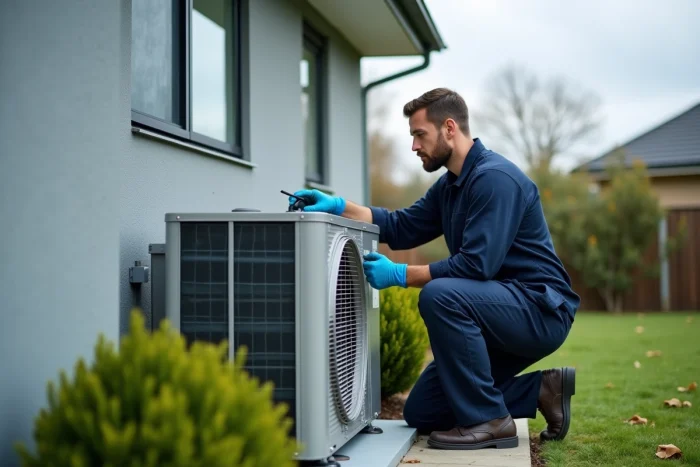
A house from the 1980s with cast iron radiators, average insulation, and an end-of-life oil boiler: this is the most common scenario when considering an air-to-water heat pump. The project seems simple on paper, but several site constraints can quickly turn a good choice into a bad experience if ignored.
R290 Refrigerant and Installation Constraints in 2025
Most guides detail how a heat pump works without addressing a recent change that significantly affects installation. Due to the F-Gas restrictions reinforced by the European Union, new air-to-water heat pumps are moving towards low GWP fluids like R290 (propane). This fluid is efficient but flammable.
In practice, this imposes stricter safety distances between the outdoor unit and the building openings (windows, mechanical ventilation, ventilation grilles). The technician must also ensure that the fluid charge remains below the thresholds allowed for a domestic installation. If you are comparing quotes, always ask which fluid is used: it changes the possible placement of the outdoor unit and the maintenance conditions.
Before finalizing a location, it is recommended to consult a qualified professional to successfully carry out the installation of an air-to-water heat pump according to the rules, taking these new requirements into account.
Noise Issues with Air-to-Water Heat Pumps: Anticipate Before Installation
Noise remains the primary source of disputes between neighbors after the installation of a heat pump. The issue is rarely discussed beforehand, yet it is on-site that it becomes apparent.
Positioning and Reverberation Effect
Placing the outdoor unit against a party wall or in a corner of the facade amplifies sound through reverberation. The direction of the airflow and the distance to the walls change everything regarding the noise level perceived by the neighbors. A gap of one meter between the unit and the wall can significantly reduce disturbance.
Several manufacturers now incorporate silent blocks and anti-vibration kits into their ranges. If this is not included, plan for it in the quote. Feedback varies on this point depending on the models, but neglecting vibrations transmitted through the ground or slab is a common mistake.
Declaration to the Town Hall and Neighbors
In densely populated urban areas, a prior declaration of work may be required for the outdoor unit. Check with your town hall before signing, especially if your home is located in a protected area (ABF). A refusal of urban planning after purchasing the heat pump can lead to costly delays that are frequently encountered on-site.
Compatibility with Existing Radiators and Hybrid Installation
Replacing a boiler with an air-to-water heat pump does not always mean changing everything. In older homes, the high-temperature radiator network (cast iron, steel) can pose an efficiency problem if the heat pump operates alone.
An air-to-water heat pump achieves its best COP (coefficient of performance) when it feeds a low-temperature circuit, typically underfloor heating or low-temperature radiators. On a high-temperature network, the COP drops and electricity consumption increases, especially in very cold weather.
The increasingly favored solution on-site is the hybrid installation. The existing boiler (gas or oil) is kept as a backup for cold spikes, while the heat pump covers the majority of needs for the rest of the year. This configuration allows for:
- Maintaining thermal comfort during prolonged freezing episodes without oversizing the heat pump
- Reducing the overall energy bill by allowing the heat pump to operate within its optimal temperature range
- Avoiding the complete replacement of heat emitters, which decreases the total project cost
The sizing of the heat pump’s power must be calculated based on a thermal assessment of the home. Without this study, there is a risk of oversizing (the heat pump cycles too often, wears out prematurely) or undersizing (insufficient comfort, overconsumption of the backup).
Financial Aid and RGE Certification: What Conditions the Application
Financial aid for energy renovation (notably MaPrimeRénov’) requires that the installer be RGE certified (Recognized Guarantor of the Environment). Without this certification, there is no aid, regardless of the amount of work.
Three concrete points to check before signing a quote:
- The RGE certification of the installer must be valid and correspond to the category of work (heating, not insulation or ventilation)
- The quote must be signed before the start of work for the aid application to be valid
- The prior technical visit by the installer is a prerequisite for sizing and validating the aid application
A poorly assembled aid application delays reimbursement by several months, or even leads to a rejection. This is regularly observed on sites where the quote was signed too quickly, without mentioning certification references.
The choice of power, the type of refrigerant fluid, the positioning of the outdoor unit, and compatibility with the existing network form a coherent whole. Treating these subjects separately increases the risks of unpleasant surprises. The prior thermal assessment remains the only reliable basis for correctly sizing an air-to-water heat pump and securing the project in the long term.