
Adidas now structures its range of football boots around four distinct families: Predator, F50, Copa, and X. Each corresponds to a specific profile of support and foot sensations, which complicates the choice for an amateur player loyal to the brand with the three stripes. The question is not simply “which model is the best,” but rather which technical silo truly corresponds to your way of playing, and on what type of surface.
FG, AG, or FG/MG soles at adidas: the choice most players overlook
Before even looking at the upper or color, the sole determines whether a boot will be suitable for your actual practice. Adidas offers several plate configurations, and their recent range strongly promotes hybrid FG/MG soles, particularly on models like the Predator Club FG/MG.
This plate combines conical studs and longer studs to maintain grip on both dry natural grass and next-generation synthetic surfaces. For an amateur player who alternates between these two surfaces during a season, it’s a relevant compromise that avoids the need to buy two pairs.
On the other hand, if you play exclusively on older artificial surfaces (short carpet, hard granules), an AG plate remains preferable. The FG/MG configuration is not designed for these more abrasive surfaces, and the studs will wear out prematurely. Field feedback varies on this point depending on the quality of the local synthetic, but the principle remains simple: identify your main surface before choosing a model.
This sole logic applies to all adidas boots, from entry-level to Elite versions. A player who buys a Predator Elite in FG to play weekly on synthetic is making an expensive mistake, regardless of the model’s prestige.

Predator, F50, Copa, X: four adidas silos for four support profiles
Adidas no longer categorizes its boots by position (forward, midfielder, defender) but by style of play and type of foot engagement. The distinction is finer than a simple marketing segmentation.
Predator: striking and stability
The Predator is aimed at players who strike often and seek precision. The upper is stiffer than on other ranges, with marked grip zones on the upper to catch the ball during powerful shots and passes. Lateral support is reinforced, which suits players who pivot a lot without necessarily sprinting.
It’s a boot that offers less immediate comfort. A player used to soft shoes may find the Predator constraining during the first uses.
F50: lightness and explosiveness
The return of the F50 range in 2024 marks adidas’s repositioning in the speed segment. The upper is maximally refined, and the plate is very responsive. This silo is aimed at sprinters, wingers, and those whose game relies on pure acceleration.
The trade-off: the ball feel is less enveloping than on a Copa. The F50 deliberately sacrifices sensation for weight and running dynamics.
Copa: modernized leather feel
The Copa remains adidas’s “feel” range. The materials are softer, with a texture close to traditional leather while incorporating modern technologies. For a technical player who prioritizes control and comfort, it’s the most suitable silo.
X: direction changes
The X range targets players who frequently make short supports, cuts, and changes of pace. The boot is very light, with a construction that favors lateral responsiveness rather than the linear push of the F50.
The table below summarizes the differences:
| Range | Playing Profile | Foot Sensation | Strength |
|---|---|---|---|
| Predator | Strikes, powerful passes | Stiff, strong support | Strike precision |
| F50 | Sprints, accelerations | Minimalist, responsive | Lightness |
| Copa | Technical, control | Soft, enveloping | Ball feel |
| X | Cuts, short supports | Light, laterally responsive | Agility |
Elite, League, or Club range: where to set the budget slider
Each adidas silo comes in several finishing levels. The Elite version represents the high-end with the most technical materials and often a laceless construction. The League version offers a compromise with similar materials but at a significantly lower price. The Club version constitutes the entry-level.
The difference is mainly felt on three points:
- The upper: Elite versions use finer and more responsive materials, while Club versions opt for thicker standard synthetic
- The sole plate: Elite plates are often made of lighter composite fiber, while Club versions use classic molded plastic
- The fit: Elite versions fit the foot more precisely, which can become a disadvantage for wide feet
For an amateur player who trains twice a week and plays on weekends, the League version often represents the best balance between perceived performance and durability. Elite versions wear out faster on synthetic due to the fineness of the materials.
Finding adidas boots online: the role of specialized football shops
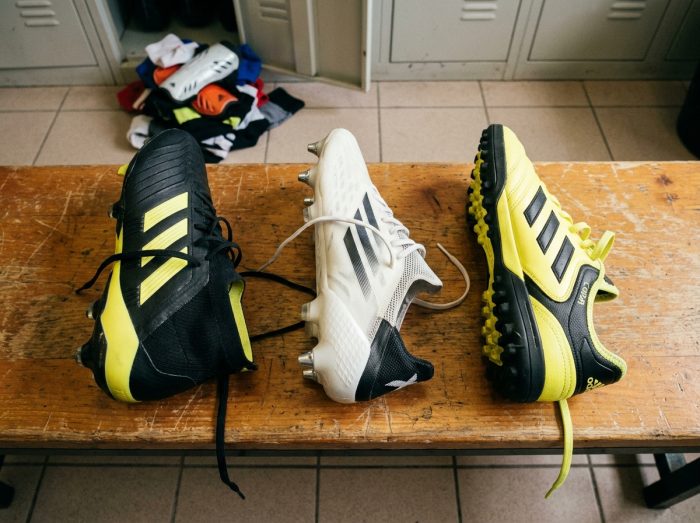
Comparing adidas models across the four silos and different finishing levels requires access to a sufficiently large catalog. Generalist shops do not always list all variations, particularly the AG or FG/MG versions that interest players on synthetic fields.
Footcenter, accessible via footcenter.fr, positions itself as a space dedicated to the world of football. This type of specialized shop groups different ranges by use and surface, making navigation easier for a player who already knows which silo interests them but hesitates between finishing levels. Football specialization also makes it easier to find specific colors and sole configurations for each practice.
Ultimately, choosing an adidas boot relies on three decisions made in the right order: the main playing surface (which determines the sole), the dominant style of play (which guides towards a silo), and then the budget (which sets the finishing level). Reversing this order, starting from price or aesthetics, remains the most common cause of a disappointing purchase.