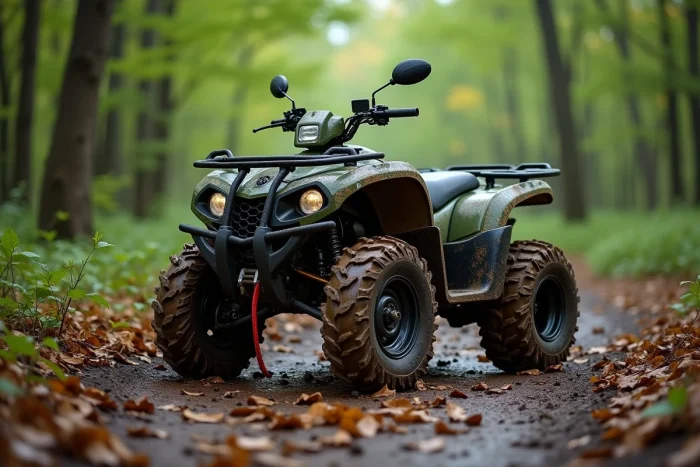
A Hytrack quad parked in a farmyard, used in the morning to tow a hay trailer and in the afternoon for a forest ride: this is the typical profile of these machines. The French brand (which has its products manufactured in Asia) has positioned itself in the utility and leisure quad market at a reasonable price, with a range approved for road use.
Understanding the true value of a Hytrack quad, from the mechanics to the parts network, requires going beyond the technical specifications and looking at field feedback.
Hytrack Spare Parts: A Game-Changing Ecosystem
Before even discussing the engine or suspension, we look at the availability of parts. A quad for which you cannot find the swingarm or rear axle outside of the dealership becomes a financial black hole by the third year.
On this point, Hytrack benefits from an often underestimated advantage. The ecosystem of independent spare parts is well-structured, with specialized sites like Kejeo offering complete front axles, rear axles, shock absorbers, and air filters for several models (HY300 4×4, HY420, among others). You can also find multi-brand compatible electronic components, notably CDI boxes sold for Hytrack and Masai, confirming that many elements are standardized or shared with other Asian manufacturers.
In practical terms, this standardization allows for securing maintenance in the medium and long term without solely relying on the official network. Before investing, one can cross-reference reviews on Hytrack quads with the actual availability of parts for the targeted model.

Hytrack Quad Range: Choosing the Right Model for the Terrain
The current range covers a wide spectrum, from small children’s quads to adult 4×4 models approved for road use. The trap would be to think solely in terms of engine displacement. The right criterion is actual usage.
Gas Models for Adults
The HY200 ST, offered at an entry-level price, is suitable for light use on flat terrain or stabilized paths. For riding with elevation changes or occasional agricultural work, the 4×4 versions starting from the HY300 X Pathfinder change the game thanks to all-wheel drive and the short range integrated into the variator. The HY300 X is available in both 4×2 and 4×4, allowing for budget adjustments based on the terrain reality.
Hytrack Electric Quads
The MP4 and MP4.8 EPS represent the brand’s electric shift. The MP4.8 EPS, positioned significantly higher in price, features electric power steering. These models target silent use (residential areas, farms near homes), but field feedback remains limited compared to gas models. The question of real autonomy in muddy or sloped conditions does not have a definitive answer at this stage.
Price Indicators for the New Range
- HY200 ST: starting at 1,990 euros, the entry ticket for an adult Hytrack quad
- HY300 X 4×4 Pathfinder: 4,290 euros, the first model with all-wheel drive
- MP4 electric: 4,990 euros, a silent alternative without road approval on certain models
- MP4.8 EPS electric: 11,590 euros, high-end with power steering
Field Reliability and Preventive Maintenance of Hytrack Quads
Recent feedback from users in leisure mode (no heavy crossing or intensive work) converges on one conclusion: reliability is deemed good when basic maintenance is respected. Several seasons of riding without major breakdowns are frequently mentioned in testimonials.
The keyword is “basic maintenance.” We are talking about concrete actions that make the difference between a quad that lasts and one that fails prematurely:
- Storage in a garage rather than outside, to protect the electronics and limit corrosion
- Battery kept charged during periods of inactivity (a maintenance charger is sufficient)
- Regular lubrication of suspension joints and cables
- Checking coolant level and air filter before each extended outing
Regarding known weaknesses, feedback varies by model and production year. The most commonly cited points of concern relate to electricity (connectors sensitive to moisture) and some peripheral transmission components. Nothing prohibitive for a quad in this price segment, but it’s better to budget for realistic annual maintenance costs rather than relying on zero defects.
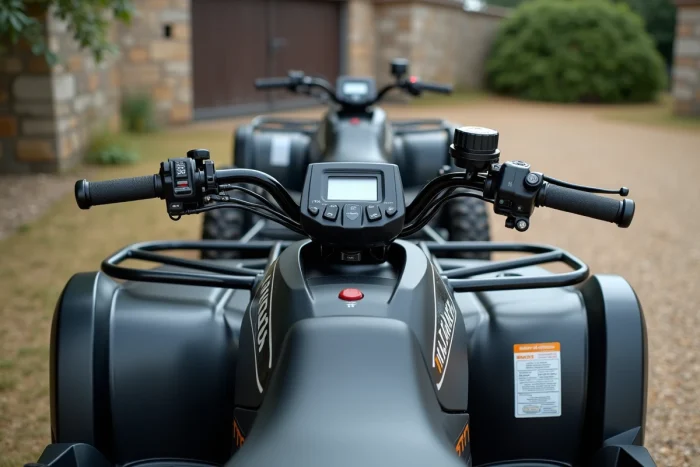
Used Hytrack Quads: What to Check Before Buying
The used Hytrack market is active in France, with good availability of recent models (510T, 400 4×4/2×4, among others) on classified ad platforms. This distribution facilitates resale but also requires diligence when purchasing.
On a used quad, the first thing to check is road approval. An approved model (registration, compliant lighting, mirrors) opens up the possibility of mixed path-road use, which expands riding routes and resale value. Without approval, the quad remains limited to private terrains.
Next, check the condition of the variator and transmission. A worn variator reveals itself through slipping on startup on inclines or abnormal belt noise. The rear axle also deserves inspection: excessive play in the CV joints or oil leaks are warning signs.
The maintenance logbook (or its absence) provides a reliable indication of the care given to the quad. An owner who has performed oil changes and replaced filters according to recommendations generally has a quad in better condition than a model with fewer kilometers but no history.
The Hytrack segment in the used market mainly targets those looking for a leisure quad rather than an intensive agricultural work tool. This leisure use is where the value-for-money remains most relevant, with resale prices consistent with new models and a controlled ownership cost thanks to the availability of parts.