Equipping a kitchen is not just about stacking accessories in drawers. The choice of kitchen equipment determines the consistency of cooking, the precision of cuts, and ultimately, the success of recipes. A few well-selected utensils cover the vast majority of needs, provided one understands what distinguishes a reliable tool from a superfluous purchase.
Compliance of kitchen utensils: what the labels don’t say
Before even discussing pans or knives, one point deserves attention: the food safety of the equipment. The “glass and fork” pictogram on a utensil indicates its suitability for food contact. For imported products, especially plastic ones, this pictogram is not enough to prove compliance. Proof relies on a declaration detailing the material, the relevant foods, the duration, and the temperature of contact.
Commercial mentions like “food grade” or “LFGB” do not constitute a regulatory guarantee on their own. Before purchasing a silicone mold or a plastic spatula, checking for the presence of a compliance declaration remains the safest reflex.
Regarding non-stick coatings, the debate around PFAS regularly makes headlines. Pans containing PTFE are still allowed for sale in France: kitchen utensils have been removed from the scope of the French law on PFAS from 2025. The European regulatory trend remains restrictive for other uses, and a change is not excluded. In the meantime, the choice between non-stick, stainless steel, or cast iron is as much about culinary preference as it is about health caution.
To explore the different categories of equipment and compare available options, the equipment on the La Petite Casserole site is a useful resource, categorized by type of utensil.
Stainless steel or non-stick pan: a choice that changes cooking
The pan alone concentrates most of the questions when equipping a kitchen for the first time. Two main families dominate: stainless steel and non-stick. Each option imposes different cooking habits.
Stainless steel tolerates high temperatures and allows for searing meats and vegetables with a pronounced Maillard reaction. However, it requires proper preheating and a bit of fat to prevent food from sticking. Its durability is nearly unlimited if one avoids violent thermal shocks.
Non-stick pans make it easier to cook delicate foods (eggs, fish, pancakes) and require less fat. Their lifespan directly depends on usage: metal utensils, overheating, or abrasive cleaning can degrade the coating within months. Replacing a non-stick pan every two to three years is not uncommon.
- For searing, deglazing, and transitioning from stovetop to oven: prefer a thick-bottomed stainless steel pan compatible with any cooktop.
- For delicate everyday cooking: a medium-sized non-stick pan, used over moderate heat, remains the most practical choice.
- For tight budgets: a single high-quality stainless steel model will last longer than two entry-level non-stick pans.
Kitchen knives: three blades are enough to cook everything
Ten-piece knife sets are visually appealing. In practice, three well-maintained knives cover nearly all cutting needs. A chef’s knife (or slicing knife) about twenty centimeters long does most of the work: slicing onions, chopping herbs, slicing meat.
A paring knife, shorter, is used for precision tasks: peeling fruit, turning vegetables, removing a potato eye. A bread knife, with its serrated blade, completes the trio with no real alternative for slicing hard crusts and puff pastry without crushing them.
Knife maintenance: the honing steel or the stone
A knife that no longer cuts is a dangerous knife. Maintenance involves regular honing with a steel (straightens the edge between uses) and sharpening with a stone (restores the sharpness over the long term). A sharpened knife reduces the risk of injury because the blade glides without forcing, whereas a dull blade slips.
Cooking and measuring equipment: the tools that structure a recipe
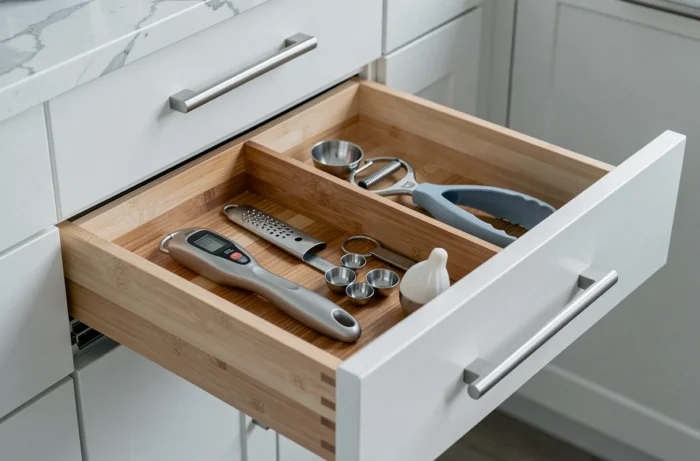
Beyond the pan and the knife, a few utensils determine the reproducibility of a recipe. A kitchen scale, preferably electronic, remains the only reliable means of respecting proportions in baking. A measuring cup complements for liquids, but the scale remains more reliable than the measuring cup for dry ingredients.
On the cooking side, a versatile pot (for soups, stews, pasta) and a medium-sized saucepan form the foundation. Stainless steel dominates here too for its longevity. Enameled cast iron, heavier and more expensive, excels in long, low-temperature cooking due to its even heat distribution.
Repairability and durability of kitchen appliances
For electrical equipment (mixers, blenders, beaters), the repairability index, mandatory in France since 2021 for several categories, is worth checking before purchase. It takes into account disassembly, availability of spare parts, and their cost. This index is starting to be replaced by a durability index for certain categories starting in 2025. Consulting this rating before investing in a stand mixer helps avoid ending up with an irreparable appliance after three years.
Well equipping your kitchen does not require an extravagant budget or an overflowing cupboard. A pan suited to your habits, three good knives, a scale, and a few sturdy cooking containers form a set that lasts over time and allows you to cook the majority of everyday dishes and recipes without material frustration.